

DTV visa Thailand: what it covers, and what not
Tick what you plan to do in Thailand. You see at once whether the DTV covers it and what the embassy says.
In short
- Remote work on a contract from homeWhat it is for
- A job with a company in ThailandNot on a DTV
- Clients in ThailandNot settled
What do you plan to do in Thailand?
Tick as many as apply; the result updates at once.
- What it is for
This is what the DTV is for. The Thai embassy in London names the purpose “Workcation (Digital nomad/remote worker/foreign talent/freelancer)” and asks for an “employment contract or employment certificate in their country or professional portfolio”. The embassy decides on your application, and the DTV is not a work permit.
Sources: Thai embassy London, DTV, updated 8 Sep 2026; Thai consulate-general Los Angeles, DTV, updated 1 Oct 2026
- Depends
It depends on your embassy. London and Los Angeles accept, for the self-employed, a “business license or business registration indicating the applicant’s name”; Budapest asks business owners for a cover letter, the certificate of incorporation and the corporate tax return. Apart from the visa, running your company from Thailand for a long time can move the place where it is managed, which matters for tax at home; your tax adviser there settles that.
Sources: Thai embassy London, DTV, updated 8 Sep 2026; Thai consulate-general Los Angeles, DTV, updated 1 Oct 2026; Thai embassy Budapest, DTV, updated 18 Aug 2026
- Not settled
No official source we could read settles this, including the embassy DTV pages. Thailand’s law on foreign workers says in general that a foreigner shall not carry out any work without a work permit. Ask the Department of Employment in writing before you send the first invoice.
Sources: Foreigners’ Working Management Emergency Decree 2017, section 8 (translation), read 10 Nov 2026; Thai embassy Berlin, DTV form, as of 28 Aug 2026
- Not on a DTV
The DTV does not cover this. You need the Non-Immigrant B business visa and a work permit from the Department of Employment. Your employer in Thailand starts the process; the Thai embassy in Berlin, for example, only issues the visa once a Ministry of Labour letter on the work permit application exists.
Sources: Thai embassy Berlin, overview of visa types, as of 1 Sep 2026; Thai Ministry of Foreign Affairs, Non-B process, 2008; Foreigners’ Working Management Emergency Decree 2017, section 8 (translation), read 10 Nov 2026
- Not on a DTV
Not on the DTV alone. If you work in your company in Thailand, you need the Non-Immigrant B visa and a work permit like any employee. According to the Immigration Bureau manual, the company needs 4 Thai employees per foreigner and paid-up capital of at least 2 million THB. If foreigners hold half of the shares or more, the company counts as foreign and needs a Foreign Business License for most services.
Sources: Immigration Bureau manual, Phitsanulok office, undated, read 7 Nov 2026; BOI, Foreign Business License, last updated 17 May 2015, read 10 Nov 2026
- Depends
The visa does not decide this; the tax follows the days. Anyone in Thailand for 180 days or more in a calendar year is tax resident there, on any visa. Thailand then taxes foreign income earned from 1 January 2024 in the year it is brought into Thailand. Have a tax adviser check it before the first transfer.
Sources: Revenue Code, section 41, read 7 Nov 2026; Revenue Department, instruction Por. 161/2566, 15 Sep 2023; Por. 162/2566, 20 Nov 2023
- Not on a DTV
The DTV is valid for five years. Whether you can get a new DTV after that, no official source we could read says. For longer stays there is the Long-Term Resident visa (LTR) for ten years, the Thailand Privilege membership for 5 to 15 years, or at 50 or over the O-A retirement visa, which you renew every year.
Sources: Thai embassy Berlin, visa types and documents, as of 2 Sep 2026; BOI, Long-Term Resident visa, read 7 Nov 2026; Thailand Privilege Card Co., Ltd., read 7 Nov 2026; Thai embassy Berlin, overview of visa types, as of 1 Sep 2026
- What it is for
This is the second purpose of the DTV. You show confirmation of enrolment or the clinic appointment. The Thai embassy in Budapest asks for an activity of at least six months; check whether your embassy asks the same.
Sources: Thai embassy London, DTV, updated 8 Sep 2026; Thai embassy Budapest, DTV, updated 18 Aug 2026
Your result
Tick what you plan to do
For each item you see the answer with its source. Here you then see whether the DTV covers your whole plan.
Contents
180 days per entry, valid for five years
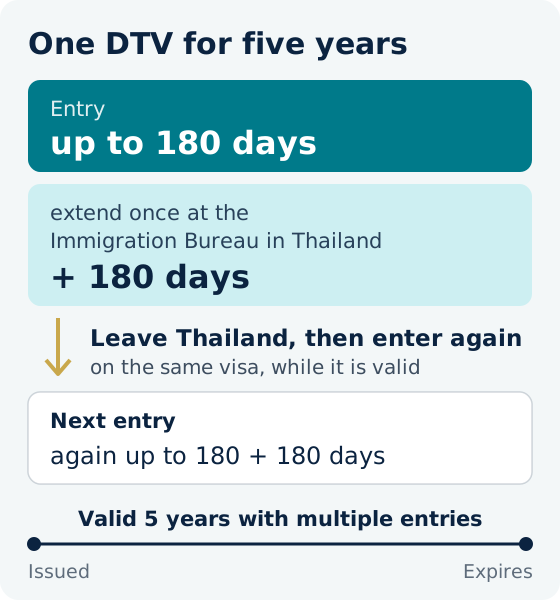
The Destination Thailand Visa (DTV) is valid for five years with multiple entries. Per entry you stay up to 180 days and can extend once at the Immigration Bureau in Thailand by up to 180 days; after that you leave and enter again on the same visa while it is valid. The Thai embassy in London names two purposes: “Workcation (Digital nomad/remote worker/foreign talent/freelancer)”, with an “employment contract or employment certificate in their country or professional portfolio” as proof, and courses or treatment such as Muay Thai, Thai cooking or a clinic.
A visa is not a work permit.
Each embassy sets its own list. Berlin also asks for a police record and proof of residence in Germany, Helsinki for proof of accommodation for at least 7 days for the first entry, Budapest for 6 months of bank statements. What counts is the embassy where you apply, or Thailand’s e-visa portal.
Work needs a work permit: the 2017 decree
Thailand governs work by foreigners in the Foreigners’ Working Management Emergency Decree of 2017, amended in 2018. Section 8 says that a foreigner shall not carry out any work without a work permit. The Department of Employment, part of the Ministry of Labour, issues work permits; for employment you also need the Non-Immigrant B visa, and the permit then runs up to 2 years per term. None of the embassy DTV pages we read mentions a work permit.
For short urgent jobs there is an exception: for up to 15 days a foreigner may do certain tasks on any visa, such as a seminar, a trade fair, a lecture, a technical inspection or repairing a machine. An employer who hires foreigners without a work permit pays 10,000 to 100,000 THB per foreigner, according to slides of the investment agency BOI.
We have not read the official wording of what counts as “work” after the 2018 amendment. That is why this page only quotes the basic rule of section 8.

Clients in Thailand: no official answer
Whether you may take on clients in Thailand on a DTV is not settled in any official source we could read. The embassies in Berlin, London, Los Angeles, Helsinki, Budapest and Bern describe the purpose and the proof, but do not allow or forbid this case in so many words.
The basic rule of section 8 still applies: no work without a work permit. So write to the Department of Employment before you send the first invoice to a company or person in Thailand, and keep the answer. Until you have it, we advise against taking on clients in Thailand.
A company in Thailand counts as foreign from half foreign shares
Under the Foreign Business Act of 1999, a company registered in Thailand also counts as foreign if foreigners hold half of its capital or more; below 50 % it stays Thai. For activities on List 3 a foreign company needs a Foreign Business License in advance. The list has a catch-all line, “other services”: services that are not expressly excluded need the licence.
Without a Thai majority, the investment agency BOI names three routes:
- Foreign Business License: with it, foreign ownership may reach 100 % for List 3 activities.
- BOI promotion: a company promoted by the BOI or the Industrial Estate Authority gets a Foreign Business Certificate instead of the licence.
- Treaty of Amity: for US citizens and US companies only. The minimum share and the application route appear only in non-official sources, and those contradict each other.
We advise against a Thai nominee who holds the majority on paper only. Since 19 October 2026 the government has run its own action against land held through nominees (“LAND ACTION”), led by the Department of Lands; at the start it named 1,397 holders with 2,360 plots. If you want to work in your company in Thailand yourself, you also need the Non-Immigrant B visa and a work permit; according to the Immigration Bureau manual, the company then needs 4 Thai employees per foreigner and paid-up capital of at least 2 million THB.
From 180 days a year you are tax resident in Thailand, on any visa
Anyone in Thailand for 180 days or more in a calendar year is tax resident there, whatever the visa; that is section 41 of the Revenue Code. Thailand then taxes income from Thailand and foreign income earned from 1 January 2024 in the year it is brought into Thailand. Income earned before 2024 does not fall under this rule.
What applies in the UK, Australia, Germany or wherever you come from is a separate question: whether you stay resident there and, if you have a company, where it is managed. We do not advise on that; a tax adviser in your home country does.
After the DTV: LTR, Privilege, retirement visa or a work permit
The Long-Term Resident visa (LTR) of the investment agency BOI runs ten years. If you work remotely for a large employer abroad, listed or with USD 50 million in revenue over 3 years, and earn at least USD 80,000 a year, or USD 40,000 with a master’s degree, you can get it as a Work-from-Thailand Professional; this group is not granted a work permit. Skilled professionals under contract with a Thai organisation who meet the BOI income threshold can get a digital work permit for 3,000 THB a year.
Thailand Privilege is a membership for 5 to 15 years from 650,000 THB and not a business visa. At 50 or over there is the O-A retirement visa. For a job, also in your own company in Thailand, you need the Non-Immigrant B visa and a work permit. A company is an option, not a requirement.
Thailand visa finder, LTR visa, Thailand Privilege, Work permit, Company in Thailand, Company in Hong Kong, Company in Singapore
The embassy decides on your visa, not us
We tell you what the official sources say and where they are silent. We do not advise on tax in your home country. We do not answer whether clients in Thailand are allowed on a DTV, because no official source settles it; only the Department of Employment can.
Frequently asked questions about the DTV visa
What is the DTV visa in Thailand?
The Destination Thailand Visa (DTV) is a five-year visa with multiple entries. Per entry you stay up to 180 days and can extend once by up to 180 days. Thai embassies such as London name the purposes “Workcation (Digital nomad/remote worker/foreign talent/freelancer)” and courses or treatment such as Muay Thai or a clinic. A visa is not a work permit.
What are the DTV visa requirements?
You show savings of 500,000 Thai baht (about GBP 11,100, USD 14,900 or AUD 21,700); the embassy in Berlin asks for statements for the last 3 months, London for GBP 12,000. For the workcation purpose you add an employment contract or certificate from your home country or a portfolio, and the self-employed show a business registration in their name. For a course or treatment, you show the confirmation. Each embassy sets its own list, so check the one where you apply, usually the embassy for the country you live in.
Is the DTV a work permit?
No. Under section 8 of Thailand’s 2017 decree on foreign workers, a foreigner shall not carry out any work without a work permit, and no embassy DTV page we read mentions a work permit. For a job with a company in Thailand you need the Non-Immigrant B visa and a work permit from the Department of Employment.
Can I have Thai clients on a DTV?
No official source we could read settles this. No embassy DTV page allows or forbids work for clients in Thailand in so many words; the general rule is that a foreigner shall not carry out any work without a work permit. Ask the Department of Employment in writing before you take on a client in Thailand.
How long can I stay in Thailand on a DTV?
Up to 180 days per entry. The Immigration Bureau in Thailand can extend this once by up to 180 days; after that you leave and can enter again on the same visa while it is valid. The DTV is valid for five years. Whether you can get a new one after that, no official source we could read says.
How much does the DTV cost?
The Thai embassy in London charges GBP 300, Berlin EUR 350 (non-refundable) and Bern CHF 350. These are embassy fees, not Strasia prices. You apply for the 180-day extension at the Immigration Bureau in Thailand.
Do I pay tax in Thailand on a DTV?
That depends on the days, not on the visa. Thailand treats anyone in the country for 180 days or more in a calendar year as tax resident. Thailand then taxes income from Thailand and foreign income earned from 1 January 2024 in the year it is brought into Thailand. What applies at home is for your tax adviser.
Do I need a company for the DTV?
No, a company is an option, not a requirement. A Hong Kong or Singapore company does not get you a visa, and as long as you are resident at home and make the decisions there, it does not save you tax. It can make sense if you live in Asia for good and have clients in several countries, for example to bundle contracts with clients in the region in one company and keep liability apart from your private assets. The condition: it is managed where you actually live. Once you are resident in Thailand, Thailand taxes foreign income earned from 2024 that is brought into the country; whether Thailand also taxes the company itself when you run it from there, we have not checked, so ask a tax adviser in Thailand.
How this guide is made
- Editorial
- Strasia Group, guides desk
- Sources
- Thai embassy Berlin, Thai embassy London, Foreigners’ Working Management Emergency Decree, BOI, Revenue Department, read on 7 and 10 November 2026
- Not verified
- Work for clients in Thailand on a DTV, the meaning of “work” after the 2018 amendment, the current penalty for workers without a permit, a second DTV after five years, a minimum age for the DTV, the full text of the Foreign Business Act and the List 3 exclusions, the conditions of the Treaty of Amity, Department of Employment fees, whether Thailand taxes a foreign company run from Thailand, and the fees and document lists of Thai embassies we did not name. The e-visa portal, the main Immigration Bureau site, the Department of Employment and the business registry (DBD) could not be accessed on 10 Nov 2026. A review by a licensed adviser in Thailand is still pending.
- Updated
- Next review
- February 2027
- Not legal advice
- Guidance based on official sources
A first assessment in 2 minutes: which location fits your goals
Select your goals, free and without obligation.
We go through your plan with you, free of charge
In a free first consultation we look at your DTV check result, your embassy’s documents and the questions that stay open. We help with the DTV as part of a package with company formation, accounting or another visa, not on its own; the embassy decides, and the DTV is not a work permit.
Reply within one business day. Tell us briefly what you plan to do in Thailand and for how long.
Sources
- Thai embassy Berlin · DTV form, as of 28 Aug 2026, read 7 Nov 2026
- Thai embassy Berlin · Visa types and documents, as of 2 Sep 2026
- Thai embassy Berlin · Overview of visa types (PDF), as of 1 Sep 2026
- Thai embassy Berlin · Visa fees, as of 18 Nov 2024
- Thai embassy London · Destination Thailand Visa, updated 8 Sep 2026
- Thai consulate-general Los Angeles · DTV, updated 1 Oct 2026, read 10 Nov 2026
- Thai embassy Helsinki · DTV, updated 3 Sep 2026
- Thai embassy Budapest · DTV, updated 18 Aug 2026
- Thai embassy Bern · DTV, undated, read 10 Nov 2026
- Foreigners’ Working Management Emergency Decree B.E. 2560 (2017), tentative translation, read 10 Nov 2026
- BOI · Slides on the Foreigners’ Working Management Emergency Decree and amendments, file of 4 Mar 2025
- Thai Ministry of Foreign Affairs · Non-Immigrant B process, September 2008
- Immigration Bureau · Service manual of the Phitsanulok office, undated, read 7 Nov 2026
- BOI One Start One Stop · Foreign Business License, last updated 17 May 2015, read 10 Nov 2026
- BOI One Start One Stop · Setting up a foreign company, as of September 2014
- Royal Thai Government · LAND ACTION, news of 19 Oct 2026, read 31 Oct 2026
- BOI · Long-Term Resident visa, read 7 Nov 2026
- Thailand Privilege Card Co., Ltd., read 7 Nov 2026
- Revenue Department · Revenue Code, section 41 (Thai), read 7 Nov 2026
- Revenue Department · Instruction Por. 161/2566 of 15 Sep 2023
- Revenue Department · Instruction Por. 162/2566 of 20 Nov 2023 (income before 2024)
- European Central Bank · Reference rates of 6 Nov 2026 (conversion)
First consultation on your DTV plan
Tell us briefly what you plan to do in Thailand and for how long. In the first consultation we go through your result with you and tell you which documents your embassy asks for and which questions to settle in writing first.
All fields marked * are required.